
Welcome to "Culture, Ecology, Change" (M.A.)
Online Office Hours
You ask, we answer.
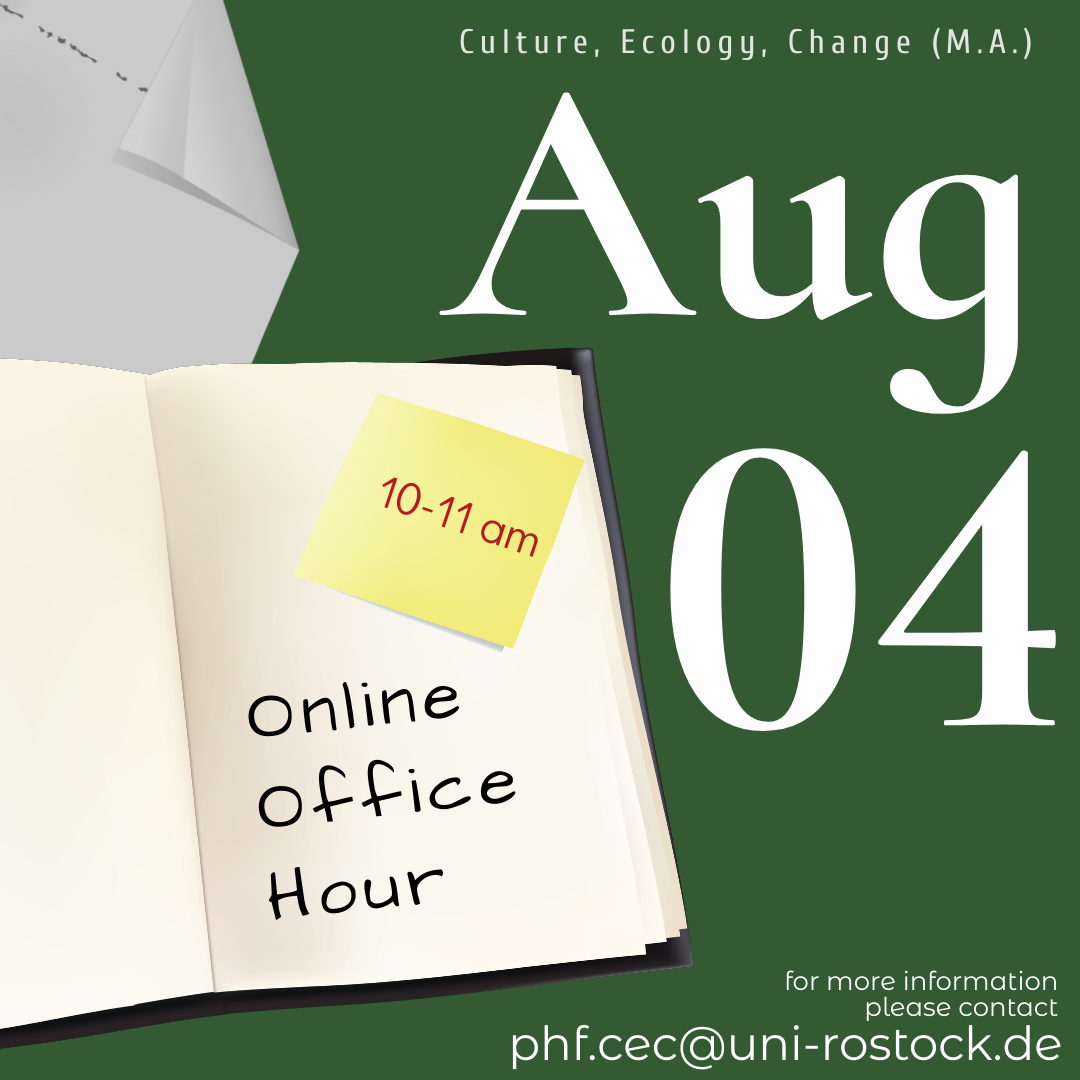
Next online office hour: August 4th, 10-11am CET
You are interested in “Culture, Ecology, Change” and want to know more? Then come talk to us.
Bring any questions you might have about the programme, the university, the city, or us - we'll answer to the best of our ability.
Next online office hour: August 4th, 10-11am CET
To join, please contact us at phf.cecuni-rostockde. You will receive a Zoom-link shortly before the session.
Remaining dates will be announced closer to the day, keep an eye on our website and/or instagram.
Climate change, biodiversity loss, uneven development, resultant demographic pressures …
We are living in a world of multiple ecological and humanitarian crises. The M.A. programme “Culture, Ecology, Change” (CEC) provides students with the skills and resources needed to understand and actively confront the complex connections between the interconnected crises of the “Anthropocene”. Join us in working towards understanding literature, culture, and language as agents in their own right, and working towards a more sustainable and just world.
About “Culture, Ecology, Change”
The M.A. programme “Culture, Ecology, Change” (CEC) understands and acknowledges literature, culture, and language as global agents in their own right. With a focus on environmental humanities and ecocriticism, the programme foregrounds contemporary theories and approaches to ecological and cultural change across a broad selection of (anglophone) global and historical contexts. It explicitly highlights the complex connections between climate change, migration, (post-, neo-) colonialism, uneven development and access to resources, as well as political responses to these crises. Taking global perspectives and historical roots into account, CEC enables students to grasp, and act upon, the interconnected condition of the present predicament. During their studies, students critically analyse current cultural narratives and artefacts, and practice contrasting them with alternative framings, or counter narratives – real and imaginary –to work towards understanding how narratives and counter-narratives might serve as blueprints for cultural change.
find us on social media
instagram @cec_unirostock
bluesky @cec-unirostock